Best Architectural Composite Siding Options: A Definitive Guide
The selection of exterior cladding is no longer a binary choice between high-maintenance natural timber and utilitarian vinyl. Modern building science has ushered in an era where composite materials attempt to solve the ancient tension between aesthetic permanence and structural durability. Choosing the best architectural composite siding options requires an understanding of how disparate materials—wood fibers, Portland cement, polymers, and resins—interact under thermal stress, moisture exposure, and UV radiation. This guide serves as a comprehensive technical and editorial exploration into the high-performance world of composite cladding.
Understanding “Best Architectural Composite Siding Options”
To identify the best architectural composite siding options, one must first dismantle the marketing jargon that often clouds the industry. “Composite” is a broad umbrella term. At its core, it refers to any material engineered from two or more constituent materials with significantly different physical or chemical properties. When these materials merge, they create a product with characteristics unlike the individual components—typically gaining strength, weight reduction, or resistance to decay.
The “best” option is never a universal constant; it is a variable determined by the specific constraints of the project. A coastal residence in Florida faces radically different stressors than a mountain retreat in the Rockies. Therefore, a high-quality composite must be evaluated based on its dimensional stability—the degree to which it resists expanding and contracting with temperature swings—and its moisture management capabilities.
A common misunderstanding is that composite siding is “maintenance-free.” While it significantly reduces the labor-intensive cycles of scraping and painting associated with cedar or redwood, it is not an install-and-forget solution. Effective architectural design acknowledges that every material has a lifecycle and a specific failure point. The risk of oversimplification often leads specifiers to choose based on visual mimicry (how well it looks like wood) rather than the chemical composition that ensures that look lasts for thirty years.
Deep Contextual Background: The Evolution of the Building Envelope
The trajectory of composite siding follows the broader history of industrial chemistry. In the mid-20th century, the architectural world relied heavily on first-growth timber. As these resources became scarcer and more expensive, the industry pivoted toward aluminum and eventually vinyl. However, these materials often lacked the “gravitas” required for high-end architectural applications; they felt thin, sounded hollow, and performed poorly in fire-prone or high-wind environments.
The late 1980s and early 1990s saw the rise of fiber cement, a mixture of cellulose fiber, sand, and cement. This was a pivotal moment in the search for the best architectural composite siding options, as it offered the fire resistance of masonry with the workability of wood. Yet, even fiber cement had its limits, particularly regarding weight and the absorption of water at cut ends.
Today, the “next generation” of composites utilizes advanced polymers and glass-reinforced resins. These materials aim to bridge the gap between the organic beauty of wood and the inorganic resilience of stone. We are currently in an era where the focus has shifted from mere “durability” to “performance aesthetics”—where the material must not only last but also contribute to the building’s thermal performance and carbon footprint goals.
Conceptual Frameworks and Mental Models
When evaluating high-performance cladding, professionals often use specific mental models to categorize their choices.
1. The Thermal Synergy Model
This framework looks at how the siding interacts with the rest of the wall assembly. A composite material with a high R-value (insulative capacity) reduces thermal bridging. The “best” choice under this model is one that complements the continuous insulation layer of the building, rather than just acting as a decorative rainscreen.
2. The Lifecycle Carbon Loop
In this model, the architect evaluates the energy required to produce the composite versus its longevity. A material that lasts 50 years but has a high initial carbon cost may be preferable to a “green” material that requires replacement every 15 years. This involves calculating the “break-even” point of environmental impact.
3. The Dimensional Stability Index
This is perhaps the most practical framework for installers. It asks: How much will this plank move? Wood-plastic composites (WPC) often have high thermal expansion coefficients. Identifying the best architectural composite siding options through this lens means prioritizing materials that remain “flat and true” regardless of the humidity or heat.
Key Categories: Performance and Trade-offs
The marketplace is currently dominated by four distinct “families” of composite materials. Each offers a unique profile of benefits and inherent weaknesses.
Fiber Cement Siding
The industry standard for durability. It is non-combustible and holds paint exceptionally well.
-
Pros: High fire rating, insect proof, widely available.
-
Cons: Extremely heavy, requires specialized cutting tools (silica dust risk), can crack if the house settles.
Engineered Wood Siding
Composed of wood strands or fibers treated with zinc borate and bonded with water-resistant resins.
-
Pros: Lightweight, installs exactly like traditional lumber, high impact resistance.
-
Cons: Despite treatments, it is still an organic-based product; if the coating is breached, moisture can lead to swelling.
Cellular PVC and High-Density Resins
These are solid-state polymers that contain no organic “food” for mold or rot.
-
Pros: Impervious to water, can be manufactured with deep, realistic grain textures.
-
Cons: Significant expansion and contraction; darker colors can absorb heat and cause warping if not formulated with “cool-roof” pigment technology.
Wood-Plastic Composites (WPC)
Often used in “cladding” formats rather than traditional lap siding, these blend recycled plastics with wood flour.
-
Pros: Exceptional sustainability profile (often high recycled content).
-
Cons: Heaviest of the options; can be prone to “sagging” if spans between fasteners are too wide.
Comparative Material Performance
| Feature | Fiber Cement | Engineered Wood | Cellular PVC | Glass-Reinforced Composite |
| Moisture Resistance | Moderate (if sealed) | Moderate | Excellent | Superior |
| Fire Rating | Class A | Class C (usually) | Class A/B | Class A |
| Installation Weight | Heavy | Light | Moderate | Moderate |
| Paint Retention | 15+ Years | 10–15 Years | N/A (Color-thru) | Lifetime (Factory) |
| Impact Resistance | Low (Brittle) | High | High | High |
Detailed Real-World Scenarios Best Architectural Composite Siding Options
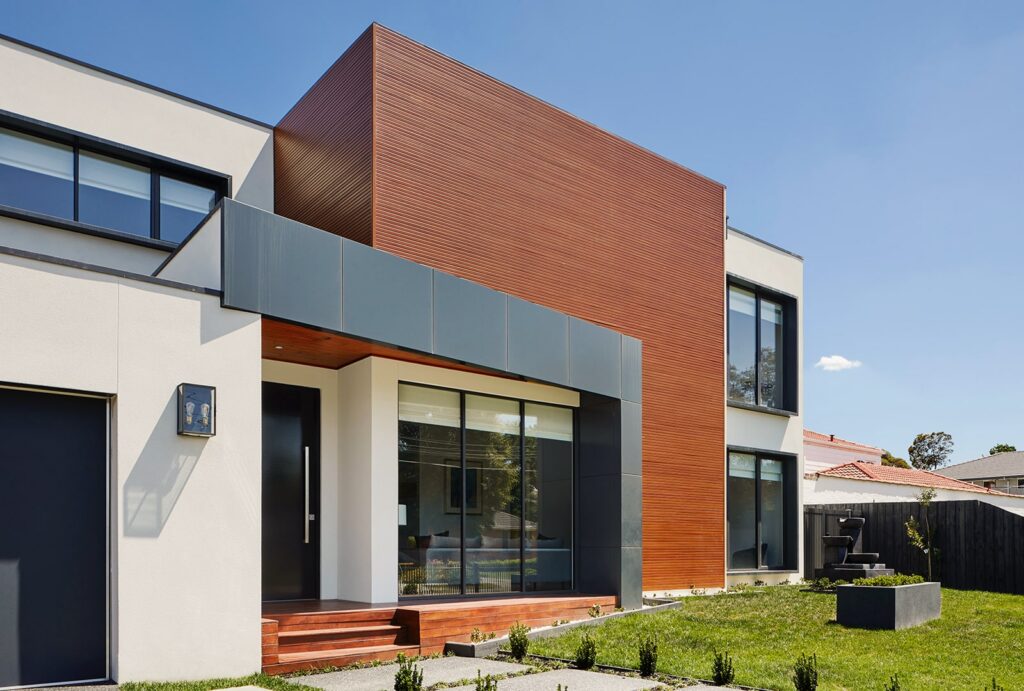
To truly understand how to select the best architectural composite siding options, we must examine their performance in the “wild.”
Scenario A: The High-UV Desert Environment
In climates like Arizona, the primary enemy is UV degradation and extreme diurnal temperature swings (hot days, cold nights). A PVC-based composite may struggle here unless it has specific UV inhibitors. Fiber cement or a glass-reinforced resin is often the superior choice because they do not “off-gas” or lose structural integrity under intense heat.
Scenario B: The Coastal Salt-Spray Zone
Here, corrosion is the concern for fasteners, but for the siding itself, the issue is moisture saturation. Engineered wood, even with zinc borate, is a riskier play. The “best” architectural choice would be a high-density polymer or cellular PVC, which effectively acts as a plastic shield against the salt-heavy air.
Scenario C: The Urban Infill / Strict Fire Code
For multi-family dwellings in dense urban areas, fire spread is the priority. Fiber cement is the go-to, but modern high-performance mineral-based composites are gaining ground. These materials are essentially “synthetic stone,” offering a level of protection that engineered wood cannot match.
Planning, Cost, and Resource Dynamics
The financial reality of siding is often split between “First Cost” and “Total Cost of Ownership.” Selecting the best architectural composite siding options requires a 30-year outlook.
-
Labor Specialization: Fiber cement requires more labor hours due to the weight and the need for respiratory protection.
-
Waste Factors: Engineered wood and PVC can be ordered in longer lengths (16′ or 20′), reducing the number of seams and minimizing off-cut waste compared to the standard 12′ lengths of fiber cement.
-
Ancillary Materials: High-end composites often require proprietary starter strips, vented rainscreen clips, or color-matched caulks, which can add 15–20% to the material budget.
Estimated Cost Breakdown (Per Square Foot)
| Material Type | Material Cost | Labor Cost | Maintenance (20 yr) |
| Engineered Wood | $3.50 – $6.00 | $4.00 – $7.00 | $2,000 (Repaint) |
| Fiber Cement | $4.00 – $8.00 | $6.00 – $10.00 | $2,500 (Recaulk/Paint) |
| Premium Resin | $9.00 – $14.00 | $7.00 – $12.00 | $500 (Cleaning) |
Tools, Strategies, and Support Systems
A successful installation of the best architectural composite siding options is dependent on the “system” behind the board.
-
Rainscreen Furring: Using 1×3 wood or plastic furring strips to create a 3/8″ gap behind the siding. This allows for drainage and back-ventilation.
-
Pneumatic Fastener Control: Over-driving a nail into a composite can create a “mushroom” effect or a stress fracture. Precision depth-of-drive adjusters are mandatory.
-
Diamond-Tipped Blades: Essential for fiber cement to ensure clean edges and minimize dust.
-
Flashing Systems: Integrated kick-out flashing and Z-flashing at horizontal transitions are more critical than the siding itself in preventing rot.
-
Thermal Expansion Spacers: Specifically for PVC and resin-based products, these tools ensure consistent gaps that allow the material to “breathe” without buckling.
Risk Landscape and Failure Modes
The primary failure mode for composite siding is Moisture Entrapment. While the boards themselves may not rot, if they are installed too tightly against a house wrap without a drainage plane, moisture can sit against the sheathing, leading to mold and structural decay of the wall studs.
Another compounding risk is Improper Clearances. Most composite manufacturers require a 2-inch gap between the siding and rooflines or hardscapes (decks/patios). Ignoring this leads to “wicking,” where water is pulled into the core of the material via capillary action. Over time, this causes delamination or “soft spots” near the bottom of the wall.
Governance, Maintenance, and Long-Term Adaptation
Maintaining the best architectural composite siding options involves a “Layered Review” approach:
-
Annual Visual Inspection: Check for gaps in caulking at window and door penetrations. Composites move; caulk eventually fails.
-
Five-Year Soft Wash: Avoid high-pressure power washing, which can drive water behind the planks. Use a low-pressure detergent spray to remove atmospheric soot and organic growth.
-
Ten-Year Sealant Audit: Remove and replace hardened or cracked sealant in expansion joints.
Adaptation Triggers
When should you stop maintaining and start replacing?
-
Trigger 1: Visible “cupping” or warping across more than 10% of the surface area.
-
Trigger 2: Softening of the material at the bottom edge (the “pick test”).
-
Trigger 3: Significant color fading that cannot be restored through specialized coatings.
Common Misconceptions and Oversimplifications
-
“Composites are just fancy plastic.” In reality, the engineering behind glass-reinforced polymers is closer to aerospace technology than a plastic toy.
-
“Thicker is always better.” A thicker board might be more “brittle.” Dimensional stability is about the ratio of components, not just the volume of the material.
-
“They all install the same way.” This is the most dangerous myth. Fiber cement is a “gravity-hang” material; many resin composites are “clip-and-track” systems. Mixing methods is a recipe for disaster.
-
“Pre-finished colors last forever.” While factory coatings are superior to site-applied paint, they still fade. The “best” options offer 15-to-30-year fade warranties, not lifetime guarantees.
Synthesis and Architectural Judgment
The pursuit of the best architectural composite siding options eventually leads to a convergence of aesthetics, physics, and economics. For the homeowner or developer, the decision should be grounded in the “Expected Service Life” of the structure. If the goal is a century-home, fiber cement or high-end mineral composites are the logical choice. If the goal is a high-performance, energy-efficient modern dwelling where speed of installation and thermal breaks matter, the newer polymer resins take the lead.
Ultimately, a “pillar” architectural choice is one that respects the local climate and the skill level of the available labor force. Even the most advanced composite material will fail if the local contractors have never seen a rainscreen system before. True topical authority in siding is found in the balance between the chemistry of the board and the craftsmanship of the envelope.